.png)
Mr.Gway Says
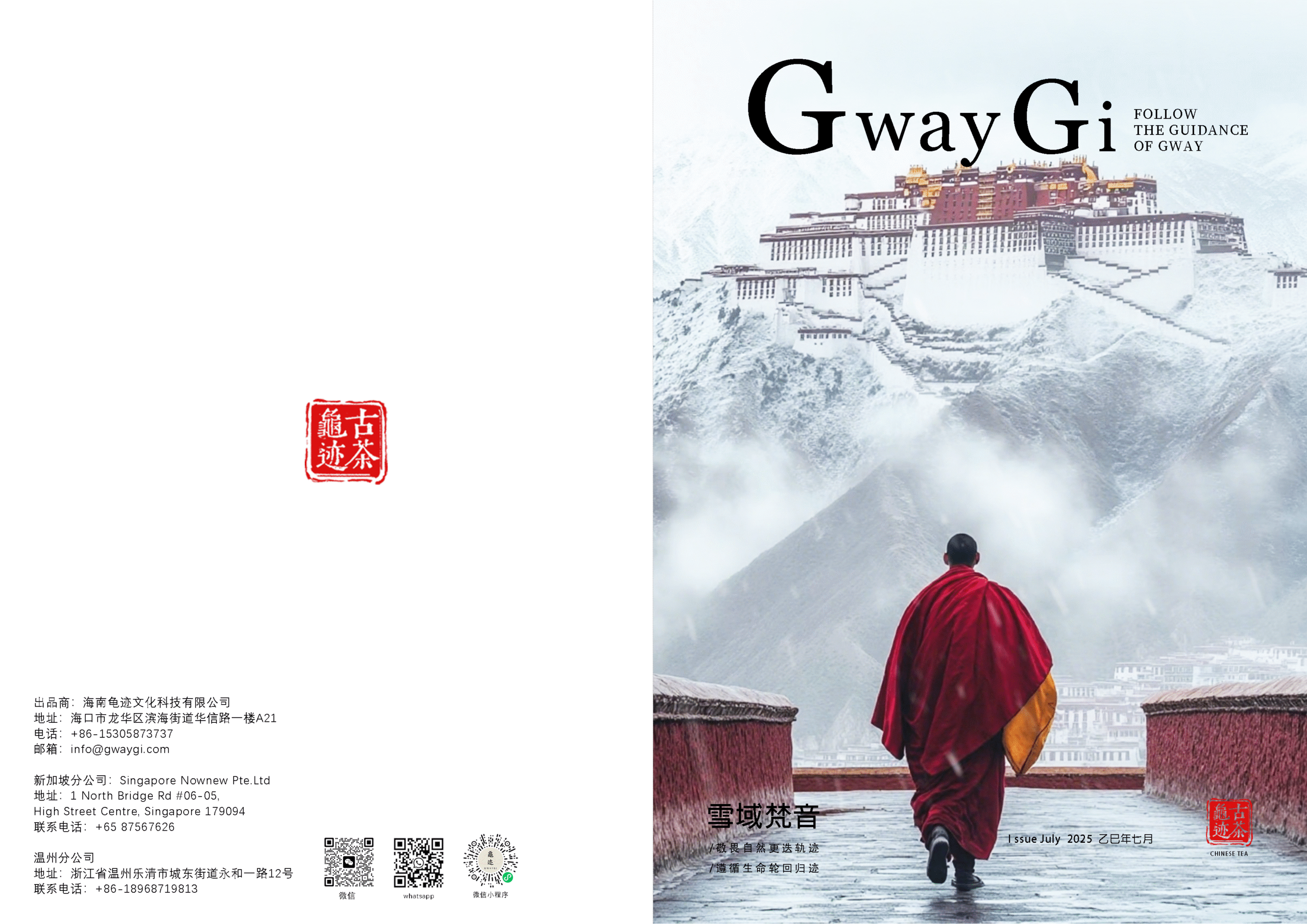
Xueyu Fanyin — A Chalice of Oracles from the Clouds
In tea gardens above 3,500 meters, the buds and leaves of Tibetan black tea must tighten their veins through nights colder than the clouds, to seal in that thread of brisk sweetness. The mountain spring, freshly escaped from the glacier, carries a crystalline edge of snow yet holds little oxygen; brewed with it, the water’s temperature is always a few degrees lower than on the plains. Thus, the tea’s fragrance lingers in the pot, reluctant to rise—like a monk turning his prayer beads, grain by grain, before speaking.
The first sip brings “emptiness”—the thin air of the highlands distilled into the tea, gently pushing your taste buds apart to leave a clear, open space. Then comes the “cold”—a chill laced with pine resin and crushed ice, like snowmelt ladled from a copper pot in the prayer hall, pricking the tongue with a subtle sting. Only at the end does the tea’s mellow richness emerge—slender, lingering—like the shadow stretched far across the summit of Mount Kailash by the setting sun, golden yet cool.
In May, tea is picked while the morning mist still clings to the mountainsides. Pickers light juniper incense, the wind horse flags damp and heavy in the fog. For every handful of tea, they softly recite the Six-Syllable Mantra; what fills the basket is not merely green leaves, but layer upon layer of folded wind horses, awaiting the boiling water to unfurl them again.
Here, black tea ferments more slowly than in the lowlands. At night the temperature drops to freezing, and the breath of microorganisms lengthens, giving rise to a fragrance like the frost-flowers in a glacier’s crevice—tinged with snow, with spruce, and with that fleeting moment of extinguishment when a butter lamp’s wick burns to its end.
A Tibetan proverb says: “Tea without salt is like water; a man without money is like a ghost.” Yet tea offered to the Buddha may not be salted—only filled with faith. Pilgrims travel for hundreds of miles, bringing tea bricks wrapped in cowhide to Lhasa. They circle the Barkhor Street three times before the tea, along with butter and tsampa, is delivered to the monastery. A monk will first offer a bowl before the Buddha, then take it back to the kitchen to brew.
The first bowl cannot be drunk; it must sit on the altar until it cools, letting the dust and breath of the journey settle into clarity.
By the time the tea is shared, the afternoon sun streams through the high windows, gilding the surface like a drifting sheet of gold leaf. A pilgrim lifts the bowl—his lips first touch the highland’s cold, thin air, then the scalding tea. Heat and cold meet between his teeth, and in that instant, he hears the low beat of the monastery drum, as if sounding from within his own chest—faith made tangible, so real that one mouthful contains the mountains, the snows, the chants, and the breath of life.
When the tea is finished, the monk dips his ring finger into the last drop and flicks it three times into the air: once for the heavens, once for the earth, and once for all beings. The droplets vanish almost instantly in the thin air—like a sigh too light to fall.
Stepping out of the monastery, the wind of the plateau sweeps up fine snowflakes. Between the teeth lingers the tea’s final aftertaste—cold, sweet, and unending—like the last chime of a prayer wheel, like the final gleam of sunset on the snowy peaks, like an empty space newly cleared in the heart, vast enough to hold the whole of Tibet.
Xueyu Fanyin—It does not clamor, yet it carries its own echo. It lets the noise settle, and the soul find a moment of solemnity and awe. Every raising of the cup is a silent pilgrimage, awakening the most primal reverence for heaven, earth, and faith.
Amid the murmuring flutter of prayer flags, the Tibetan people entrust their souls to the boundless sky. Their full-body prostrations, their journeys of a thousand miles, seek nothing but blessings for all beings. A single, quiet sigh holds the deepest compassion for the world’s suffering.
To taste Xueyu Fanyin is like hanging a prayer flag woven by your own hands—each sip becomes a dialogue with the sacred, each breath of wind a blessing, carrying a wish for peace upon this world.
Surrounding the tea, there’s always more tea, just as at the end of the road, there’s always another road. This too mirrors the path and return of life.
May you,
Sway freely, and live on without end.
Xueyu Fanyin
Origin
Tea—In the long history of Tibetan agriculture, it was once absent.
For centuries, tea had to journey across towering mountains and deep valleys, carried along the ancient Tea-Horse Road from Yunnan, Sichuan, Nepal, and India.
It wasn’t until the peaceful liberation of Tibet in modern times that tea cultivation truly began.Tea trees from Sichuan’s Mengding Mountain were introduced,marking the birth of Tibet’s own tea-growing legacy—
home now to the highest-altitude tea plantations in the world.
Compared to the millennia-old tea traditions of inland China,
Tibet’s tea gardens are like young children.The oldest trees here are only 50 to 60 years old,and in this land, such trees are already revered as “old-tree tea.”
From the southern foothills of the Nyenchen Tanglha Mountains in Nagqu,the tea’s roots follow the mighty Yarlung Tsangpo Grand Canyon,nourished by the warm, moist currents from the Indian Ocean,
and by the snowmelt from sacred mountains such as Nayong Gapo.
Here, clouds shroud the peaks year-round,winters are mild, summers never harsh.In this sanctuary of clouds and snow, tea grows slowly—picked only once a year.It’s this slow pace, in concert with the pristine environment,that gives rise to tea leaves unusually rich in caffeine, amino acids, and polyphenols—often surpassing even the finest teas from older traditions.
From the gardens of the high Himalayas—lacking oxygen, but never lacking faith.
1.png)
Craftsmanship and Tasting Notes
This Himalayan red tea is crafted from leaves picked from tea trees over 40 years old.Harvested in early May, each tender shoot—just one or two leaves—is carefully handpicked.
Traditional wood-fired methods are used for the kill-green process,
followed by slow fermentation and drying over local ebony wood,
preserving the tea’s most primal and natural essence.
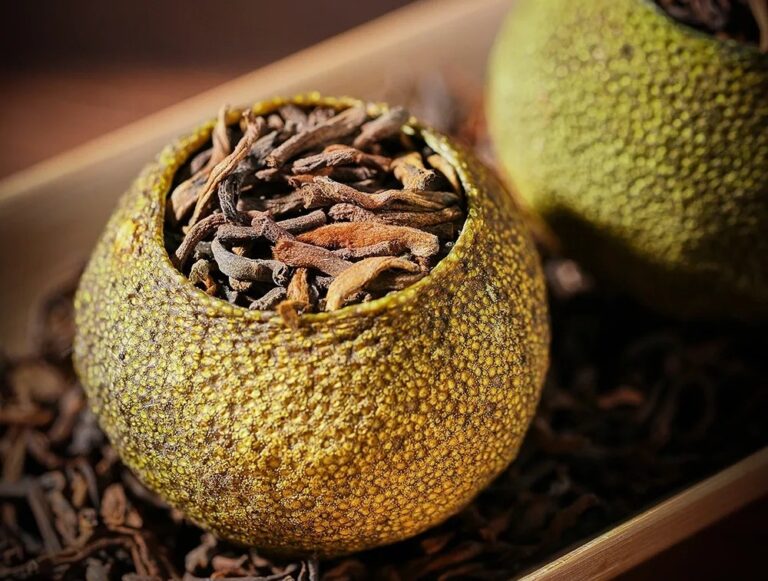
The dry leaves offer a dense, grounded aroma.Once brewed, the fragrance rises elegantly,
the liquor glows a vibrant amber-red, with a soft halo.Notes of wildflowers, honey, and mellow sweetness unfold with each sip.
Tasted mindfully, it reveals the breath of snowfields, the vastness of high altitudes—a bold, spirited aroma, yet never overpowering.
It is a tea that speaks with quiet strength,echoing the raw vitality of untouched nature.
Brewing Guide and Suggestions
Flavor is deeply personal.We believe in drinking tea the way you feel it—freely, joyfully, intuitively.Light or strong, every cup is a reflection of your mood, your body, and your moment.
Just like makeup—be it subtle or striking—it is beautiful, as long as it suits you.
- Gongfu Brewing (for layered aroma and depth)
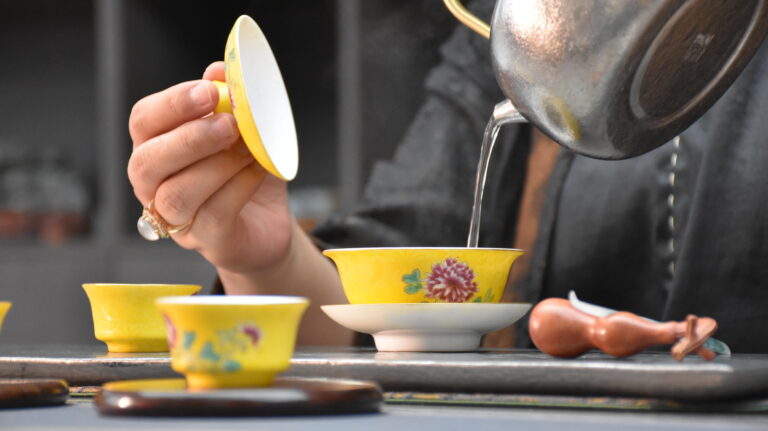
Recommended teaware: porcelain gaiwan, glass or silver teapot.
Warm all utensils with hot water, including the brewing vessel, fairness cup, and drinking cups.
- Use 5g of tea for 120ml water (tea-to-water ratio 1:25).
- First 5 infusions: ~90°C (Quick rinse at low temperature). Pour gently to avoid splashing onto the leaves directly. Steep for ~8 seconds.
- 6th–10th infusions: 100°C boiling water, 8 seconds.
- After 10th: gradually increase steeping time.
Always pour out the tea fully between infusions to avoid bitterness.
If possible, use open flame or charcoal to boil water—this adds depth and a hint of firewood warmth to the flavor.
- Thermos Brewing (for smooth, steady strength)
Suitable for travel or daily convenience.
- Use a clean, odorless thermos (around 500ml); add 2.5g of tea.
- Fill with 90°C water and steep for 20 minutes before your first sip. Remember to swirl the pot gently before pouring
- After pouring out half the tea, refill with hot water. Steep another 10 minutes.
- Continue this cycle, always leaving some “mother liquor” inside for continuity.
General rule: the more tea or the higher the temperature, the shorter the steeping time. Adjust to taste.
Benefits
Among the six traditional categories of Chinese tea, red tea is fully fermented and known for its warmth and gentleness.
It is suitable for people of all ages, especially for those with delicate digestion or a weak stomach.
Grown in the world’s highest-altitude tea gardens and nourished by pristine glacier melt,“XueYu FanYin” is shaped more by nature than by human hands.Its most distinct trait lies in its crisp, cool vitality—
the paradox of a steaming hot brew that leaves a refreshing, alpine clarity on the palate.
It is particularly suited to summer: easing internal heat, calming the stomach, and refreshing the mind.
Rich in vitamins, beta-carotene, polyphenols, catechins, theaflavins, and trace minerals,this tea supports a healthy microbiome, enhances digestion, strengthens the gut lining, stimulates gastric secretion,
and fortifies the immune system—offering both warmth and wellness in every sip.
About Water for Brewing Tea
Water is the mother of tea.Since the time of Lu Yu, the “Sage of Tea,” connoisseurs have revered water as essential to the art of brewing.
In his classic The Classic of Tea, he wrote:“Among waters, spring water from the mountain is best; river water comes next; well water is the least desirable.”
Though it is rare today to access mountain spring water,we recommend using pure distilled water for brewing.The best tea deserves the purest companion.
In essence, good tea water should be: clear, flowing, light, sweet, and cool.
Storage Recommendations
To preserve the integrity of your tea over time:
- Store in an airtight container
- Keep away from light, moisture, odors, and drastic temperature shifts.
- Each tea canister comes with a clip to seal out air after opening.
- When stored under proper conditions, this tea can maintain its quality for an extended period.
Customized Service
We offer bespoke gift sets, crafted to hold the very moments of beauty and warmth you long for.
Give it to:
The one who devours books with unquenchable curiosity,
The one who walks beside you, sharing cups and laughter,
The one you find again in a fleeting glance amidst the lights,
The one whose wisdom is etched in every line upon their brow,
Give it to all those you cherish in this world…