.png)
Mr.Gway Says
Chaozhou Wudong Mountain, at the Break of Dawn
In the dim hour before sunrise, the roasting basket glows with a faint blue light—like a cluster of stars pressed low by the night. The tea master spreads the withered, shaken Dancong leaves into the bamboo tray. As the temperature slowly rises, the leaves curl, groan, and release their raw green scent, as though enduring a harsh trial. Yet only by surviving more than twelve hours of this “ordeal by fire” can the fragrant compounds hidden in their veins be rewritten—methyl anthranilate, linalool, nerolidol… like spirits summoned awake, arranging themselves in the dark.
At that moment, I suddenly understood Lan Fenghuang.
Jin Yong wrote of her: “With a laugh, the venom and poison scattered like dust.” But what he did not write was this: before that, her blue robe had also been dyed red in the holy flames of the Five Poisons Sect. She tested venom with her own body, fed her poisons with her own blood, and only then won her immunity to all toxins.
For her, fire was a baptism. For Dancong, it is the same.
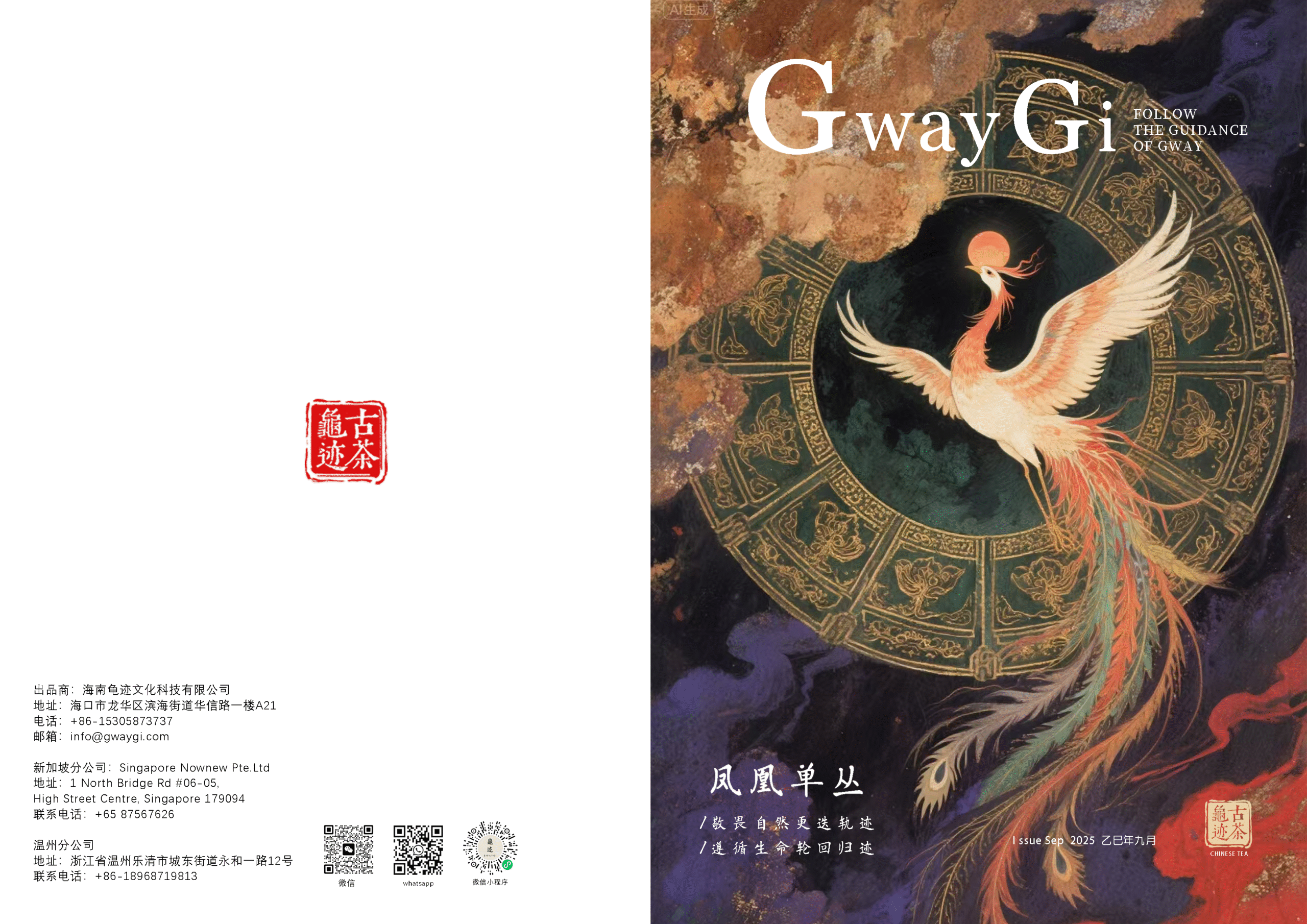
Phoenix Dancong—a cup of freedom in the martial world.
If green tea is like spring water newly freed, white tea like moonlight unstained, and dark tea like a furnace’s slow-brewed liquor, then Phoenix Dancong is the long wind blowing through southern mountains, the carefree melody of a flute across rivers and lakes—unrestrained, uncommon, and beyond replication.
It is born among rocks and crags, yet transforms heaven and earth into fragrance. Through fire it is reborn, yielding infinite “single-tree, single-fragrance” expressions. It carries the wildness of mountains, yet tames the heart with delicate floral and fruity aromas.
To drink it is to glimpse Lan Fenghuang of The Smiling, Proud Wanderer—robes flying, laughter untamed. She cares nothing for the rules of the martial world, nor the eyes of society, but lives only by her own rhythm—bold, dazzling, and uniquely her own. Phoenix Dancong is the very embodiment of this carefree spirit and freedom.
Tea and the martial world alike prize one word: ease. Ease is not escape, but the ability to smile and let go after countless trials, battles, and entanglements.
And so, I raise my cup to the wind and moon—
The roads of the martial world are long, the tea’s smoke fierce.
Remember that on Wudong Mountain, century-old trees still stand,
guarding the fragrance reborn from fire.
May you, too:
Sway freely, and laugh at the martial world.
Fenghuang Dancong
Origin and Growing Environment
Fenghuang Dancong belongs to the oolong tea family, a semi-fermented tea produced exclusively in the Phoenix Mountain region of Guangdong. Each Dancong is crafted from a single tree, cultivated, harvested, and processed individually, according to its unique fragrance, and passed down through generations.
Wudong Mountain, at elevations above 800 meters, is the core production area. Among its natural villages, Hucu, nestled within ancient forests at over 1,100 meters, is the crown jewel. Enveloped in mist year-round, with day-night temperature swings exceeding 15°C, its tea trees grow slowly in high humidity and minimal disturbance. The soil—formed by ancient volcanic eruptions—is rich in minerals and organic matter, deep, and well-drained. The gnarled trunks of century-old tea trees, covered in moss and lichens, root themselves in rocky crevices, endowing the leaves with a sweet, mellow “high mountain charm” and distinctive cong yun (aged-tree resonance).
Today, fewer than a thousand century-old tea trees remain in Hucu’s ancient gardens. Yields are scarce; each leaf carries the pristine ecology of Phoenix Mountain and the wisdom of Chaozhou’s gongfu tea artisans.
Our Fenghuang Dancong is exclusively sourced from Hucu, Wudong Mountain.
Representative Fragrance Types
Ya Shi Xiang (Duck Shit Fragrance)
The legendary Ya Shi Xiang began as a chance mutation within the Dancong family tree. Belonging to the Pomelo Flower fragrance lineage, it evolved from the traditional Da Wu Ye variety. Its leaves are smaller, thicker, and glossy black-green beneath the sun. Officially named “Yin Hua Xiang” (Silver Flower Fragrance), the farmers’ earthy nickname Ya Shi Xiang proved far more compelling.
After two careful rounds of roasting, the dry leaves are tightly twisted, dark brown. Lift the lid of a warm gaiwan and inhale: hot, a sharp citrus note rises; cold, the cup bottom reveals almond-milk sweetness woven with pomelo blossom. Roll the liquor around your mouth for three seconds before swallowing, and savor the fragrance’s rise and fall through mouth and throat.
Mi Lan Xiang (Honey Orchid Fragrance)
Old-tree Mi Lan Xiang from Hucu thrives in deep mountain hollows. With roots that stretch far into the soil, these trees draw abundant nutrients, creating teas dense with internal compounds and marked by the prized lao cong yun (old-tree resonance). In both aroma and depth of flavor, it is the truest expression of Fenghuang Dancong as “perfume in a cup.”
Twice roasted with precision, it marries rich honey sweetness with delicate orchid fragrance. The honey arises from natural sugars enhanced by the baking process; the orchid from varietal character and high-mountain terroir.
- First infusions: high honey aroma
- Middle steeps: orchid blooms layer upon layer
- Finish: lingering sweet fruit notes
Its fragrance endures, evolving with every sip.
La Mei Xiang (Wintersweet Fragrance)
From Hucu’s ancient groves, old-tree La Mei Xiang is a rare small-variety Dancong, preserved in limited quantity, never widely propagated. It carries the unique imprint of Wudong’s high-altitude, old-tree terroir.
Its fragrance blends orchid as the base with honeyed richness, forming a winter-plum-like aroma—sweet, elegant, lingering. Twice roasted, it displays both high-mountain resonance and aged-tree depth. Scarce and distinctive, La Mei Xiang offers tea lovers a fresh joy in exploring Dancong’s diversity.
Ba Xian (Eight Immortals)
To drink Dancong without tasting old-tree Ba Xian is to miss something essential.marked by the prized lao cong yun (old-tree resonance). In both aroma and depth of flavor, it is the truest expression of Fenghuang Dancong as “perfume in a cup.”
Legend says that in the Guangxu reign of the Qing dynasty, farmers cut branches from the Ba Xian mother tree (a Da Wu Ye variety) and successfully propagated eight offspring. Each carried the mother’s exquisite fragrance and flavor, yet with subtle distinctions. Their collective brilliance recalled the tale of the Eight Immortals crossing the
The name reflected farmers’ high hopes, and resonated with traditional symbols of prosperity. In Chaozhou business circles, Ba Xian became known as the “Boss’s Tea,” promising thriving trade and fortune.
Ba Xian is anchored in orchid-like zhi lan xiang. Its fragrance is refined and noble, with notes of orchid and gardenia, touched by honey and fruit. The liquor shines golden, tasting fresh, mellow, and long-sweet, with enduring mountain resonance and impressive re-steepability.
Ye Lai Xiang (Night-Blooming Jasmine Fragrance)
Known as the “Soul of the Moonlit Night,” the mother tree of Ye Lai Xiang originates on Wudong Mountain.
Legend has it that a tea farmer first discovered it during a night harvest. As the leaves were processed, their fragrance intensified step by step, filling the night with rising “water aroma.” When the kill-green was complete, the tea was named Ye Lai Xiang.
Our selection comes from second-generation trees over 150 years old. Quantities are limited, available only for connoisseurship.
The dry strips are tightly twisted, long, and lustrous pale-brown. The liquor glows golden and bright. The aroma is rich, distinctly floral—like the night-blooming jasmine—with a sweet, refreshing, and unique flavor. Its texture is smooth, layered, and resilient. Mid-steeps reveal a delicate pear-like fragrance. The aftertaste lingers long in the mouth, stimulating salivation and refreshing the spirit.
Brewing Method
Teaware: Choose a white porcelain gaiwan (to highlight pure fragrance) or a Zhuni Yixing teapot (to enhance body).
Warming & waking the tea: Rinse the vessel with boiling water. Use about 1:20 leaf-to-water ratio. Lightly shake the dry leaves to awaken their aroma
Pouring technique: Pour in boiling water, no need to rinse the tea, For the first three brews, steep no longer than five seconds to avoid over-brewing. After pouring, leave the lid slightly ajar to prevent trapped heat from dulling the fragrance..
Extending steeps: For the 4th–6th brews, steep about 10 seconds. From the 7th onward, increase each infusion by about 5 seconds, savoring the evolving layers.
Extra delight: Old-tree Dancong can also be boiled. Use hot water only (cold water makes it bitter). The boiled liquor is thicker, with stronger woody notes.
On Brewing Water
Water is the mother of tea.
Since Lu Yu, the Tea Sage, tea connoisseurs have placed utmost value on water. In The Classic of Tea, he wrote: “Best is mountain spring; next, river water; least, well water.” Later works summarized good water in five words: clear, flowing, light, sweet, cold.
On Storage
Follow universal tea-storage principles: airtight, away from light, moisture, and odors. Once opened, expel air and reseal promptly to avoid dampness and oxidation.
With proper storage, Dancong keeps well over time. New tea shines with freshness and sweetness; aged tea gains depth and thickness.
Customized Service
We offer bespoke gift sets, crafted to hold the very moments of beauty and warmth you long for.
Give it to:
The one who devours books with unquenchable curiosity,
The one who walks beside you, sharing cups and laughter,
The one you find again in a fleeting glance amidst the lights,
The one whose wisdom is etched in every line upon their brow,
Give it to all those you cherish in this world…